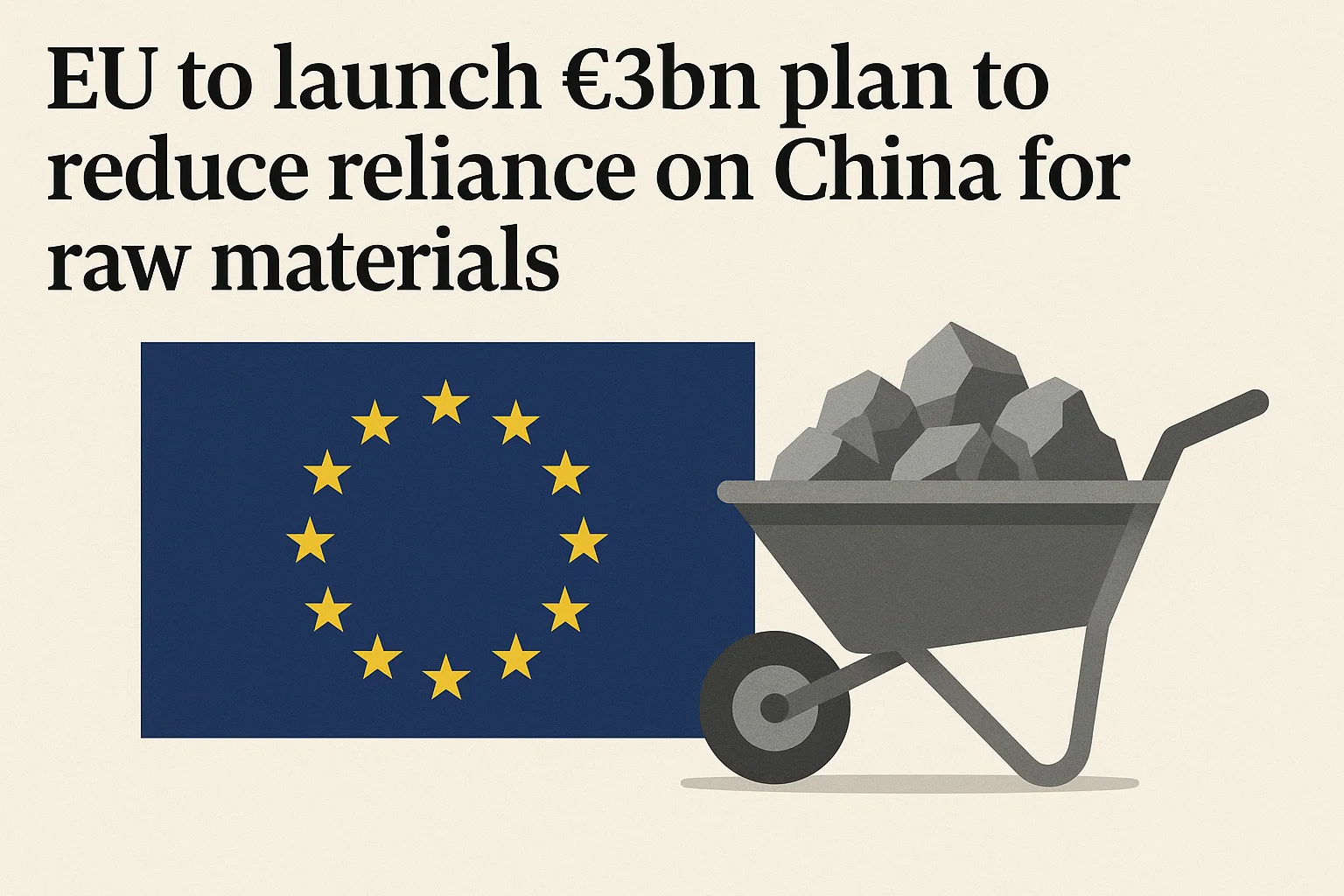
The European Union (EU) is rolling out a major strategy to reduce its heavy dependence on China for critical raw materials. The new plan roughly €3 billion in funding aims to transform how the EU sources, processes, and recycles raw materials essential for clean energy, automotive, and high-tech industries. With growing geopolitical pressure and China’s dominant position in rare-earth and metal processing, the EU says it must act now to secure long-term supply chains and industrial resilience.
The “EU” appears early and often because this move aligns with decades of European industrial policy and recent supply-chain vulnerabilities. By linking mining, recycling, financing, and regulation, the plan marks a crucial shift toward resource autonomy for the bloc.
What the €3 bn plan covers: new mining, recycling and supply-chain diversification
The plan launched under the name REsourceEU will channel €3 billion into about 25–30 strategic projects across mining, processing, and refining of critical materials. These include developing new mines for lithium, molybdenum and other metals, upgrading processing capacity in the EU, and boosting recycling.
The plan also aims to support a shift away from Chinese supply dominance. According to EU officials, many critical minerals such as rare earth metals, graphite, lithium, and others are currently processed almost entirely in China.
The goal is to reduce this dependency over a multi-year period. REsourceEU signals the bloc’s ambition to build a diversified supply-chain network including domestic production and recycling to reduce risks tied to relying on a single external supplier for vital raw materials.

Recycling & circular economy: a fast-track toward raw-material self-reliance
Because building new mines and processing facilities takes years, recycling is at the heart of the EU’s strategy for near-term security. Under the broader Critical Raw Materials Act (in force since May 23, 2024), the EU aims to recycle 25 % of its annual demand for critical raw materials by 2030.
Today, the actual recycling rate for rare earths in the EU is below 1 %.The REsourceEU plan sets up incentives for waste collection, metal scrap retention within the bloc, and recycling infrastructure to turn end-of-life products into valuable inputs.
If implemented successfully, recycling could quickly reduce external sourcing needs shrinking Europe’s raw-material vulnerabilities while supporting green-tech industries like EVs and wind turbines.
Governance, stockpiling and supply-chain resilience: policy levers in the new plan
The plan does more than provide money: it envisions structural reforms. Under REsourceEU, the EU calls for stricter oversight of supply-chain sourcing, potential legal obligations if industries don’t diversify voluntarily, and the creation of a joint stockpiling platform for strategic materials.
This includes planned restrictions on exporting scrap metal and waste outside the EU, beginning with permanent magnets and possibly aluminium and copper scrap by 2026.
By pooling demand and orders across companies and countries, the EU aims to secure better terms and prices sacrificing short-term cost savings for long-term supply security.
Challenges ahead: cost, timing, and Europe’s industrial gap
Despite strong ambition, experts warn that building a self-sufficient supply chain for critical raw materials will prove difficult. Specialists note that mining, refining, and processing such materials is far more complex than simply sourcing gas or oil.
Cost is another hurdle: mining and processing in Europe tends to be more expensive than relying on established low-cost suppliers such as China.
Moreover, establishing processing infrastructure from mining permits to refining plants typically involves long lead times, environmental approvals, and potential public resistance. That makes full scale-up before 2030 difficult.
Finally, even the EU’s own legislation acknowledges full self-sufficiency is unlikely. The Critical Raw Materials Act projects the bloc will still import some materials and rely on international trade, albeit through more diversified and secure channels.
What REsourceEU means for industries: electrification, clean tech, and supply-chain security
Industries reliant on rare earths, lithium, cobalt and other critical raw materials such as automotive, clean energy, semiconductors, and defense stand to benefit significantly if the plan succeeds.
- Electric vehicle manufacturers could see more stable lithium and rare-earth magnet supply chains, reducing production delays linked to Chinese export controls.
- Wind-turbine and clean-energy firms might rely on recycled or domestically-produced materials, cutting exposure to geopolitical supply risk.
- Semiconductor and high-tech firms may find supply more predictable and less subject to external shocks.
A consolidated supply-chain ecosystem and stockpiling mechanism would also smooth price volatility, making long-term planning easier.
Timeline & Key Milestones
| Period | Expected Actions | Strategic Significance |
|---|---|---|
| 2025–2026 | Allocate €3 bn to 25–30 projects; begin mining, processing, recycling builds; create stockpile platform | Start of diversification and supply-chain reshaping. |
| 2026 onwards | Enact scrap-export bans; enforce supply-diversification rules; boost recycling output | Reduces reliance on foreign imports; recirculates EU metal waste. |
| By 2030 | Reach recycling target of 25 % of consumption; boost domestic processing; cut import dependency significantly | Improved resilience, lower geopolitical risk. |
This roadmap mirrors the ambition of the Critical Raw Materials Act and shows how the EU intends to shift from dependency to partial self-sufficiency.
Why the EU is acting now: geopolitics meets industry risk
China’s 2025 moves to restrict exports of rare earths, permanent magnets and advanced metals have jolted global supply chains. The disruption hit European automakers, semiconductor producers, and clean-tech firms.
EU policymakers fear this is not a one-off crisis. They now see access to critical raw materials as a matter of economic security and sovereignty. The REsourceEU plan is meant to safeguard industry from future supply shocks and geopolitical manipulation.
The EU’s move also reflects a broader shift in global trade policy from cheap, global supply chains toward strategic resilience and resource diversification. Don’t miss our recent post about [anchor text].
Bottom Line
The EU’s €3 billion REsourceEU plan marks a decisive pivot toward raw-material autonomy. By combining mining, processing, recycling and strategic stockpiling, the bloc aims to reduce its dependence on China and safeguard key industries. Success could bring more stable supply chains for EVs, clean energy, semiconductors and defense and lessen vulnerability to external geopolitical pressures. Implementation will not be easy given cost, regulatory and technical challenges. Yet this plan offers a concrete path to a more secure, resilient supply-chain ecosystem for Europe by 2030.
Disclaimer:
This article is for informational purposes only and reflects publicly available information as of December 3, 2025. It does not constitute legal, financial, or professional advice.