Table of Contents
A Mobile Spray Booth gives painters a controlled space when the job cannot be moved easily. That matters more, as repair teams, fleet operators, and industrial contractors keep pushing work closer to the job site. OSHA requires mechanical ventilation in spray areas to move flammable vapors, mist, and overspray away from workers.
The EPA also requires many spray-applied coatings to be applied inside a booth or prep station under its 6H rule. These rules make portable containment more than a convenience. They make it part of safer, cleaner work planning.
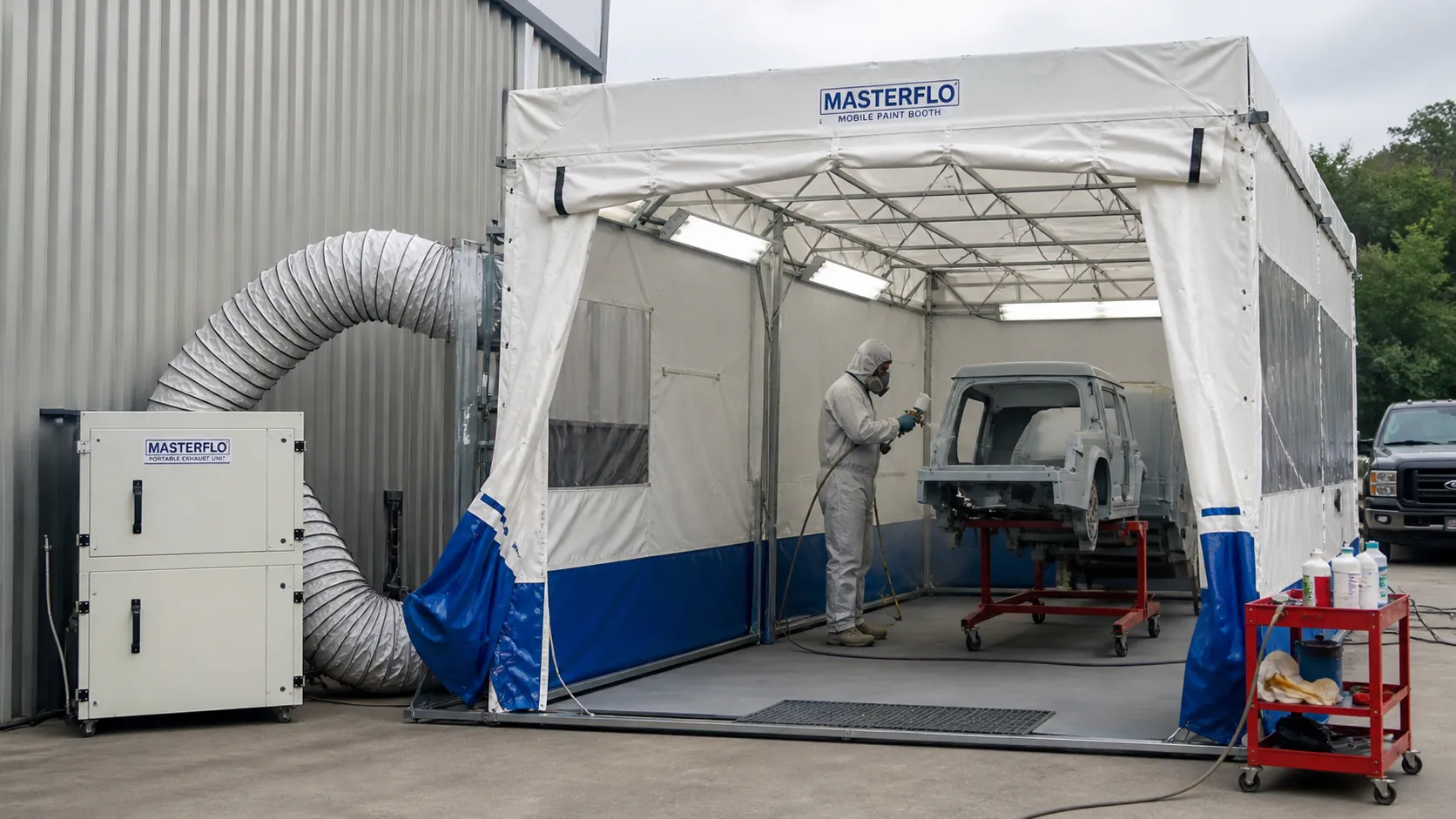
A well-designed Masterflo mobile system can help teams manage airflow, overspray, lighting, and workspace limits without building a permanent paint room.
What Is a Mobile Spray Booth?
A controlled space that moves with the job
A Mobile Spray Booth is a temporary or movable enclosure used for spray painting, coating, touch-ups, and refinishing. It can support work on vehicles, equipment, panels, furniture, and metal parts. Some units use retractable walls, inflatable structures, or modular frames. Others work as compact enclosed booths for smaller components. The main purpose stays the same. The booth separates spray activity from the surrounding area and helps control airborne paint particles.
A strong system usually includes filtered intake air, exhaust filtration, lighting, and side containment. OSHA states that spray areas need mechanical ventilation during spraying and after spraying. That makes airflow a core feature, not an optional upgrade.
Why Mobile Spray Booth Systems Matter Now
On-site painting needs flexible compliance
A Mobile Spray Booth matters because many projects are not practical inside a fixed shop. Fleet vehicles, heavy equipment, trailers, and large industrial parts often stay near the work site. Moving them can add labor, downtime, and transport costs. A mobile booth helps teams bring controlled coating conditions closer to the asset.
EPA’s 6H rule covers certain paint stripping and surface coating work. It targets hazardous air pollutants, including chromium, lead, manganese, nickel, and cadmium. The rule says certain spray work must happen in a booth or prep station. For full vehicles, the booth or prep station needs four complete side walls or curtains and a complete roof.
Workshops can also improve refinishing results by using surface coating best practices during sanding, cleaning, and spray application.
Core Features of a Quality Mobile Spray Booth
A useful Mobile Spray Booth starts with airflow. Ventilation should pull overspray away from the painter and toward the exhaust path. Filters then capture paint particles before air leaves the booth. EPA guidance for 6H-related operations requires booth exhaust filters with at least 98% filter efficiency for paint overspray in covered uses.
Strong booths also need clear access points, durable walls, stable framing, and bright lighting. Fire safety also matters when coatings contain flammable or combustible materials. NFPA standards are widely used for fire and explosion risk controls in spray application work.
Best Uses for a Mobile Spray Booth
A Mobile Spray Booth works best when the object is large, hard to move, or time-sensitive. It can support touch-up work, repair jobs, coating prep, and controlled refinishing. It also helps reduce paint drift in shared workspaces.
Common uses include:
- Fleet vehicle panel repair and refinishing.
- Heavy equipment coating at industrial sites.
- Small-batch parts painting in workshops.
- Marine, trailer, and utility body touch-ups.
- Temporary production overflow during busy periods.
- Furniture, metalwork, and fabrication coating tasks.
A mobile setup can improve organization when teams use it correctly. It gives painters a defined spray zone and helps nearby workers understand boundaries. For better coating results, teams should also understand The Role of Surface Preparation in Preventing Paint Peeling.
Key Facts Table:
| Topic | Verified Fact | Why It Matters |
|---|---|---|
| OSHA ventilation rule | Mechanical ventilation is required in spray areas | Helps remove flammable vapors, mists, and residues |
| EPA 6H booth rule | Covered spray work must use a booth or prep station | Supports hazardous air pollutant control |
| Full vehicle booth setup | Four side walls or curtains and a complete roof | Improves containment for vehicle coating work |
| Subassembly booth setup | Full roof and at least three walls or curtains | Supports smaller parts and equipment coating |
| EPA filter benchmark | At least 98% overspray filter efficiency | Helps reduce paint particles in exhaust air |
| Main use case | On-site painting and refinishing | Reduces the movement of large or difficult assets |
Mobile Spray Booth vs Fixed Spray Booth
A Mobile Spray Booth is not always better than a fixed booth. A permanent booth may offer stronger infrastructure, higher production capacity, and easier permitting for daily operations. It can also support repeated work with stable airflow and controlled utilities. That makes it useful for high-volume body shops or manufacturing lines.
Mobile systems shine when location flexibility matters most. They can support temporary jobs, field service, and smaller production needs. They may also help businesses avoid dedicating floor space to a permanent structure. For better coating quality, painters should follow professional paint preparation tips before applying any primer or finish coat.
Safety and Setup Considerations
A Mobile Spray Booth should be planned before paint is mixed. Teams should review coating safety data sheets, ventilation needs, electrical setup, fire controls, and filter replacement schedules. OSHA’s spray finishing standard requires ventilation to run during spraying and long enough afterward to exhaust vapors from drying materials. That point matters because risk does not stop when the spray gun stops.
Work areas also need clean floors, safe walk paths, and controlled ignition sources. Painters should use approved personal protective equipment based on the coating product.